


Think back on the last two weeks. How many meetings did you sit through where you thought this is a complete waste of time?
Regardless of the role you typically play in meetings, Whether you are the meeting planner, facilitator, or an attendee, and that meeting is with your team, colleagues, or your son’s Soccer team, you can turn those boring, pointless, and unproductive meetings into valuable events for all attendees.
In this article, you’ll learn some tips on having better meetings, from determining when and how to plan a meeting to figuring out meeting logistics, facilitating the meeting, keeping stakeholders on topic, and following up on action items.
How to Manage Meetings Effectively
1. Determine the purpose of the meeting.
Before you plan a meeting or agree to attend a meeting, determine the purpose. Ask yourself the following questions:
- What are the objectives of this meeting?
- What is the goal? What do we need to get out of this meeting?
- What decisions need to be made?
- What is the agenda?
- What is the appropriate meeting length and time?
2. Follow a meeting framework.
Follow a meeting framework to ensure that your meetings are productive and efficient. Remember—just because a project team member or stakeholder might request a meeting doesn’t mean you should have a meeting. Respect people’s time.
A framework can help teams determine when to schedule a meeting and if a meeting is warranted in the first place. If not, then resort to email, Slack, or another instant chat application or medium.
3. Build a meeting process.
After developing a meeting framework, you now need a process. That process should include the following steps:
- Determine the purpose of the meeting.
- Plan meeting logistics. Determine the right medium (in-person, virtual, or both?). Determine the appropriate length of time.
- Prepare an agenda and include it in a meeting invitation, or distribute it via email in advance.
- Communicate the process for the meeting to all stakeholders.
- Facilitate the meeting. Clarify discussion points, decisions, action items, and due dates.
- Send meeting recaps via email (or another platform, such as a project management software).
4. Prepare an agenda.
Never—I repeat, NEVER—send a meeting invitation without an agenda. If it helps, use a meeting agenda template for each type of meeting. This relates to defining the purpose of the meeting to begin with.
Here is just one example of a meeting agenda template I use:
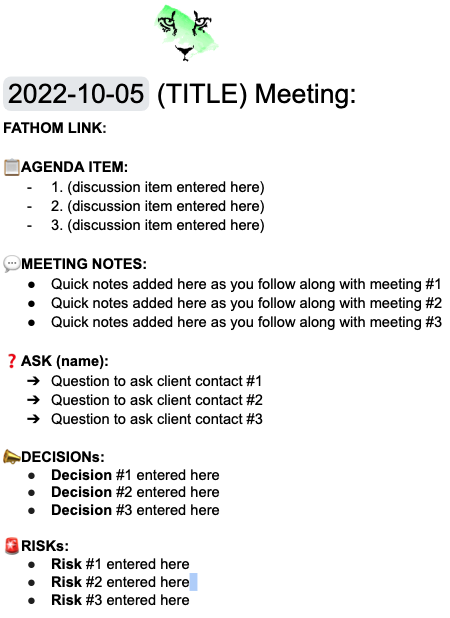

Preparing an agenda is one step, but preparing the content is another. When you take the time to compile notes, a list of questions to ask, and goals for what you want to get out of the meeting in advance, you will feel better about the meeting in general. There’s no better feeling than coming out of a meeting and thinking, “That was very productive.” A well-planned meeting is a productive meeting.
5. Prepare for the meeting.
Everyone has their own process for preparing for a meeting. It might be making notes related to the status of your work, a list of questions to ask, or a presentation. Regardless of what “prep work” for a meeting looks like for you, the point is to make ample time for proper preparation. There’s nothing worse than going into a meeting—or jumping from meeting to meeting—without feeling prepared.
6. Set ground rules.
In our digitally-driven era, meetings might blend in-person and virtual. If your meetings often occur via Zoom, practice proper Zoom etiquette, and encourage meeting attendees to do the same.
You can also create a “Do’s and Don’ts” document highlighting best meeting practices to enable attendees—and yourself—to conduct themselves appropriately. This can also help to enforce accountability.
7. Take notes.
Taking notes is a must-do, regardless of your role in the meeting. Although it might be tedious or even considered “old school,” it’s still important for keeping track of decisions, risks, and action items. It also provides good documentation and accountability for the items discussed and assigned.
Building a note-taking framework can help. Of course, your framework might look a little different depending on the meeting type and purpose. For example, are you presenting a solution to a group of stakeholders, or are you listening to a seminar?
Suppose you are the meeting facilitator or presenter. In that case, it can be difficult to present on a particular topic, facilitate the meeting, and take notes simultaneously, especially if you are screen sharing a PowerPoint or Google slide deck. I highly recommend using Fathom, especially if you facilitate and lead many Zoom meetings. Fathom changed my life.
Fathom is an AI notetaker that integrates directly with Zoom, automatically records meetings, and provides complete transcripts. Fathom also has a desktop app that allows you to make notes in real time (if you choose to) and categorize them as action items, insights, red flags, and others. These categories and notes later appear in the transcript after completing the meeting.
8. Manage meeting attendees.
Have you ever facilitated a meeting, and stakeholders and attendees totally derailed the agenda, despite your best efforts at preparing an agenda and distributing materials in advance?
Me too…
As project managers, we are often stakeholder managers as well. Therefore, it’s up to us, as meeting facilitators, to recognize when a conversation is no longer productive and move on. But how do you do this politely? That brings me to my next point…
9. Practice the art of “Skilled” interruptions.
I was raised to have manners—to be polite, courteous, and respect others. However, I’ve learned recently that being polite doesn’t always get things done in the world of business, and this is something I have personally struggled with throughout my career.
I also know that healthy and productive debate, conflict, and arguments can be beneficial, especially in creative or brainstorming sessions. However, it’s still necessary—and acceptable—to (tactfully) interrupt others in order to make sure I understand something or to keep a meeting or project on track. This can be very difficult to determine, which is one reason why setting ground rules is so important. When the conversation is no longer productive, politely interrupt to remind stakeholders of the ground rules and the agenda and get the conversation back on track.
10. Kill the meeting altogether.
Meetings are incredibly expensive. Therefore, ensuring they have a clear purpose and deliver value is important. If they don’t, then kill them. Don’t be afraid to ask the question: “Does this need to be a meeting?” or “Am I needed in this meeting?” If you don’t ask the question, who will?
11. Take action.
“It’s up to you to clarify.”
– Chinese fortune cookie
Get into the habit of emailing meeting summaries, recordings, and assigned action items and due dates to meeting stakeholders.
Waste of time? Not really—more like accountability.
When properly planned, prepared, and scheduled, meetings can improve team collaboration, productivity, and problem-solving. And with the proper tools and documentation, you can ensure everyone is accountable for their action items.
However, without the proper prep work, your meeting will be… well, just another meeting.

 bossladyworld.com