

You constantly feel like you are in disarray, disorganized, and downright dissatisfied.
You often forget about important events, to pay your bills, and you always seem to be losing your damn keys.
You start projects and don’t finish them. You say you will do things but then lack follow through. You have great ideas, but you struggle with bringing them to life.
Think about or plan for the future? You are having a hard enough time keeping your life together right now. Who has time?
If any of these scenarios sound like you, then you probably already know your life needs a little organization makeover.
I have been a project manager—in both the “corporate” world and as an independent consultant—for over 15 years. In addition to managing my consulting and coaching business, I have served as a mentor to friends, family, colleagues, and other professionals who have approached me for help with becoming a project manager, starting their own businesses, and reaching their goals.
In this article, I will share some tips and tricks on how to “project manage” your own life so you can keep better track of your day-to-day responsibilities, help you get more things done, and achieve your goals easier.
And, no, you don’t have to be a project manager to be able to do any of them; it just requires shifting your mindset and thinking differently about how you approach your day.
Keep in mind: I will share some general tips and explain what has worked for me, but keep in mind that I share what has worked for me as an example, that doesn’t mean that it WILL work for you or that you SHOULD do it.
10 Tips for Project-managing Your Personal Life and Maximizing Productivity
1. Set goals and a goal-setting system.
You can’t achieve much in life without goals. You can set goals for every decision, project, or task, regardless of how trivial or minuscule it might seem. The process of goal-setting and goal-reaching not only helps us actually achieve what we want in life, but that feeling of accomplishment and fulfillment gives us the confidence we need to set future goals and successfully achieve them.
For example, you might want to set a goal to work out more. That’s a great goal, but saying and doing it are two different things. Furthermore, merely saying, “I’m going to work out more,” is already setting yourself up for failure. You have to take it one step further and define what more means to you. Ask yourself: What is more? 2-3 times per week? 5 times per week? Every day? Does more mean doing more of a certain exercise? “I want to run longer and farther,” “I want to lift more weights,” “I want to train for the hockey team or a dance competition.”
Specificity is important for goal setting. For example, when you specify your goal further, from “I’m going to work out more” to “I’m going to run for 30 minutes 3 to 5 times per week” or “I’m going to lift my body weight for 30 minutes at least twice per week”, your goal not only becomes more specific, but it also sets you up for success.
Now, let’s go back to the subject of organizing or PM’ing your life. What do you want to achieve from it? If you are reading this blog because you are saying to yourself, “I need to get more organized”, before you continue reading, think about, or write down a more specific goal, such as:
“I want to tackle at least 3 personal projects this month.”
“I want to close 3 new clients this month.”
“I want to finish my workday 1-2 hours earlier every day.”
“I want to save $10,000 by the end of the year.”
“I want to increase my score by 100 points on my next performance review.”
This is the first step in creating a successful goal-setting system.
2. Discover your best work style and habits.
The next step is to figure out what works best for you. How do you like to work? When do you like to work? Do you rely on your phone or tablet for reminders? Do you use a calendar, planner, or budget journal? Do you use a whiteboard on the fridge? Do you prefer the good ‘ol, write-it-down to-do list?
Take some time to answer these questions. Write down several ideas to try out. Then, see what sticks.
3. Find a tool to help you manage your day.
After discovering what methods and habits work best for you, find a tool or system, and integrate it into your daily routine. Again, this could be a handwritten to-do list, an app on your phone, a calendar, a planner, or a journal. There’s no right or wrong tool; the only “wrong” tool is one that doesn’t work for you. Choose one that you will use consistently and work it into your everyday life.
If you haven’t checked it out already, I highly suggest Notion. It is easy to set up and use within minutes, even if you aren’t a project manager. Notion recently released a new feature that allows you to integrate your assigned tasks on your calendar application.
Here’s a quick guide on using Notion.
4. Prioritize.
While continuously looking at a sea of tasks, errands, places to go, and people to see, it’s easy to get overwhelmed just by looking at your calendar or your seemingly endless to-do list. There just aren’t enough hours in the day!
Here’s a secret: There are enough hours in the day—you just might not be prioritizing or managing your energy levels properly.
What do I mean by this? Most of us think, “but what if EVERYTHING is a priority?” It probably is, but that is also unrealistic.
There are two steps to prioritizing tasks and projects:
1) Focus on what you can realistically accomplish in a day.
This means being honest with yourself, your team or colleagues, your boss, or your clients. If your boss, team, or clients are constantly throwing things on your plate, don’t be afraid to raise your hand and ask, “What are the priorities?” Remember, others usually aren’t aware of what is on your plate. Even if it’s obvious to you, that doesn’t necessarily mean it’s obvious to others.
Keep priorities to only the top three. Anything more than three is unrealistic to make any real, meaningful progress on.
2) Develop a prioritization system or framework.
One of the most common prioritization frameworks we see in the business world is the Eisenhower Matrix.
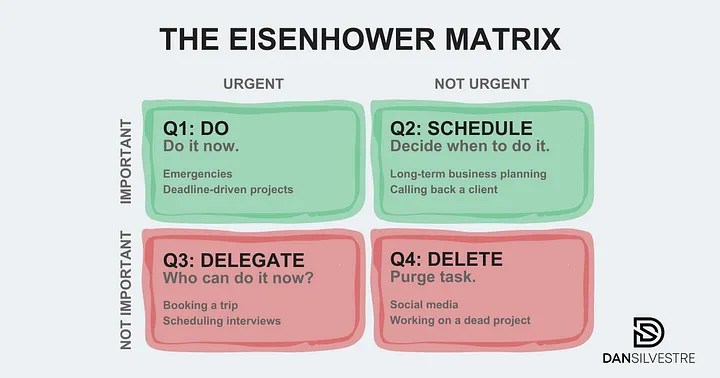
Do a brain dump of all the things on your to-do list. Don’t worry about the order of importance or sequence; simply write them all down as they come to mind. Then, take each item on your to-do list and put it in the appropriate quadrant.
You can also categorize your tasks into groups or themes. Then, choose the top three “themes” that are most important, and prioritize those.
By limiting yourself to focus on what you know you can realistically handle during the day, you set yourself up to successfully complete what you know you need to get done, and without feeling overwhelmed with all the other trivial, minuscule tasks.
5. Set deadlines.
Once you set clear goals, you understand your individual work habits, and you have a tool in place to help you manage it all in a way that works best for you, the next step is to set deadlines.
You might groan at the thought of setting deadlines for yourself. After all, don’t you deal with deadlines enough?
Visualizing and setting mental goals for the day, week, month, and even several months, and then scheduling deadlines can help you to make progress each day. Making progress toward your goals regularly will give you confidence and even more motivation to continue working towards them.
The key here is to set realistic deadlines. Be fair and honest with yourself. Remember, deadlines should motivate you rather than stress you out.
6. Build systems.
Eating healthy. Saving money. Running errands. Making plans. Planning a wedding or a vacation. Making decisions. Organizing a home improvement project.
Regardless of how big or small your project or goal, remember that everything you can or need to do in life can be managed by simply creating systems.
Now, by “system” I’m not necessarily referring to a technological system or software; a “system” is essentially a process that you follow to do a thing. That process should be reliable, repeatable, and scalable.
For example, you can have systems for cleaning your house (maybe you use a robot vacuum and set it to vacuum a certain time every day), cooking meals (maybe you “meal prep” at the beginning of each week), managing a family calendar (maybe you use a digital calendar or a whiteboard on the refrigerator), or for work.
These are all examples of systems. The more systems you create, the easier it is to manage your home, work, and life, and the more efficient you become.
7. Time block and managing time.
If you are someone who struggles with time management, then this point is for you. Time management can be broken down into two categories: monitoring how much time you spend on a task, and estimating how much time a task will take. However, there is one easy solution to both of these: a time-tracking app.
Here are the benefits of using a time-tracking app:
- You will see where your time is going.
- You will see how much time you spend on certain tasks.
- You will be able to better estimate how long tasks should take.
Once you have a better understanding of how and where you spend your time, as well as your overall productivity levels, you will also discover what distracts and interrupts you. To combat common interruptions and distractions, try the “time blocking” method. This means separating yourself from distractions so you can focus on working on specific projects or tasks.
This might also mean saying no more often to others’ requests and obligations. If you are someone who has a hard time saying “no” (I definitely am one of them!), then try this awesome tech trick.
So, time blocking your day, week, or month might mean something different for you, but I suggest blocking time out of your day for your top three priorities. They could be work, home or family life, exercising, or studying. Whatever they are, pick the top three, schedule them, and stick to your schedule.
I’m not suggesting to not help others. And, of course, there are emergency situations that require you to drop everything. However, it comes down to setting boundaries, and allocating times for helping others and times for yourself and your commitments.
8. Manage your energy levels effectively.
In many cases, some people think they struggle with time management when, in reality, they struggle with energy management. The secret to productivity is energy, not time. Energy management is everything.
The truth is that everyone experiences their peak energy levels (or when they are most creative and productive) at different points during the day. This is what we mean when we say that some people are “morning” people and others are “night owls”.
You likely already know when your peak energy levels occur, as these are natural points during the night (or night) when you feel more apt to work—maybe that’s first thing in the morning, or maybe it’s 2 AM. There’s no right or wrong time. You will find that you get more done, and you will do your best work when you are naturally wired to work.
Once you have discovered your optimal energy times, the next step is to develop and cultivate habits that feed your energy, motivation, and creativity. After all, good habits define energy levels. Some examples include:
- Exercise
- Meditate
- Eat healthily
- Get enough sleep
- Drink enough water
- Go for outdoor walks
- Surf Pinterest or Instagram for inspiration
I am a morning person by nature. Therefore, I time block and schedule my “deep, focus work” sessions between 6 and 9 AM. For all you “night owls” who are reading this, you might think I’m crazy. But I know this is when I do my best work. So, I save all my creative projects and tasks that require a lot of brain power and focus for that time block each day.
9. Don’t multitask.
Why do we multitask? It’s simple: We have too much on our plates and can’t allow ourselves to focus on one task at a time. Although we think we are being more productive by conquering multiple tasks simultaneously, we really aren’t. In fact, multitasking actually makes you less productive—by as much as 40%!
Rather, spend each day focusing on certain “themes” or categories, or different streams of thought or activities. For example:
- Monday is cleaning day.
- Tuesday is laundry day.
- Wednesday is a “no meeting” day so you can focus on work.
- Thursday is finance day for paying bills, budgeting, and financial planning.
- Friday is creative work day.
That is just an example, of course. The point here is that if you try to cram in ALL those activities every single day, not only will you burn yourself out, but you rob yourself of being able to do your best work. This is because you aren’t allowing yourself sufficient time to properly transition from task to task or project to project.
10. Optimize.
Finally, the key to successfully project-managing your life is discovering what works for you. Build a process or system for yourself. Follow it. Optimize it. Improve it. With time, patience, and practice, you will begin to see that you are more productive, getting more done, and taking more control over your life.
Principles to Live—and Work—By
All in all, you don’t have to have an MBA, certification, or 20 years of professional experience to properly organize and project manage your life. You simply need to figure out what you need to do personally. It might require some personal development and reflection on your part, but once you figure this out, you can then develop the necessary work habits and principles to work better and live better.
Develop the Right Habits
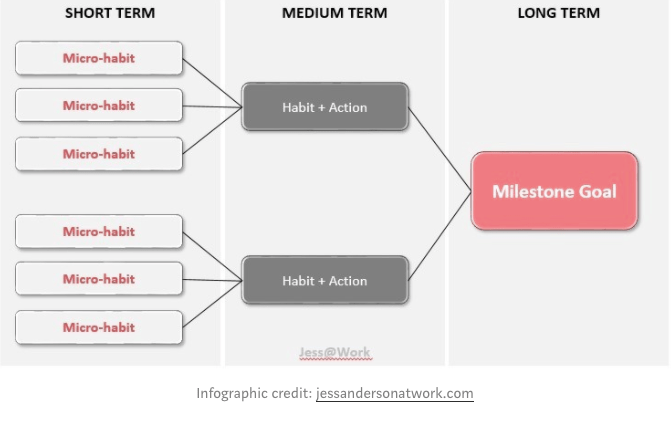
Remember, it takes the average human being approximately 21 days to form a new habit. You might also have to start by forming micro-habits and slowly build up to more challenging habits. So, be sure to give yourself time to adapt to working in a different way. Don’t expect them to work immediately.
Work Smarter, not Harder
If you don’t take anything else away from this article, the most important thing you can do is rest. If you are constantly saying “yes” to people, projects, and things, and running yourself ragged, you aren’t really being productive, you are only burning yourself out. You can absolutely define productivity and “time block” your schedule to include rest and relaxation time for yourself. Work smarter, not harder.

 bossladyworld.com