


“Let your conversation be gracious and attractive so that you will have the right response for everyone.”
– Colossians 4:6 NLT
We all have our own ways of communicating. Some of us were raised with solid communication skills; others were less fortunate.
Regardless of your upbringing and personal and professional experiences, we can all become great communicators.
I won’t lie. Altering your communication habits is difficult, especially when you are accustomed to a specific communication style (or lack thereof) for most of your natural life. Additionally, recognizing the risks embedded within communication and “catching” them before they amount to misinterpretations and miscommunications is even more difficult.
I maintain an Accomplishment and Error log (using Airtable). Each accomplishment and error is categorized according to our goals and principles. When I look back through my error log over the years, the most common error category is miscommunication mishaps and misinterpretations with clients. This could be related to misinterpreting client expectations, making assumptions, or simply thinking we are on the same page when we aren’t.
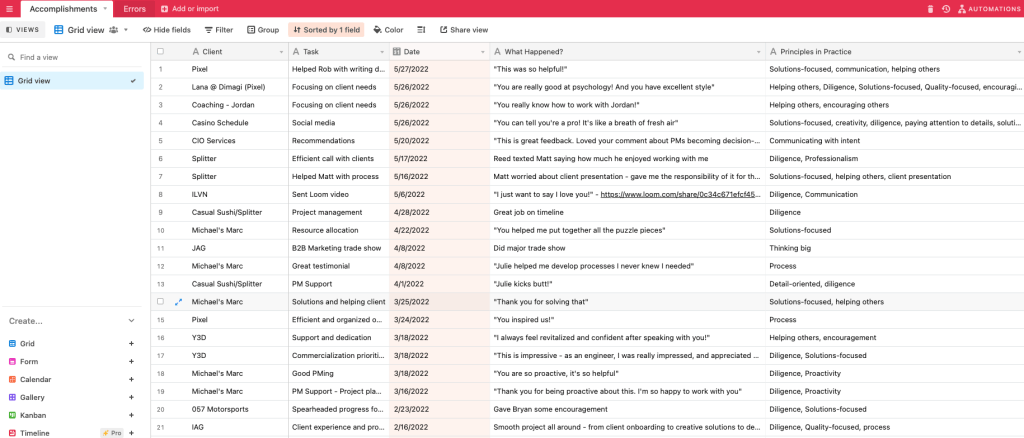

After reflecting, I ask myself: What measures can we take to prevent these types of errors?
By practicing effective communication.
In this article, I’ll explore the differences between effective and ineffective communication, the factors that impact the communication process, and how to apply effective communication in your daily life. I’ll also provide steps for developing a communications plan so you know exactly how to communicate and when in order to achieve a desirable, favorable outcome.
How to Apply Effective Communication to Your Daily Life
First, let’s define effective and ineffective communication.
Effective communication occurs when the information or desired result reaches the other party or listener successfully and in a timely manner.
Ineffective communication occurs when information does not reach the other party, or the desired result is not achieved. Ineffective communication also requires significant time and effort.
We can all recall ineffective conversations, both at work and in our personal lives. When a client, colleague, spouse, or partner has a different communication style than we do, it can be a huge challenge, especially if they don’t naturally communicate well, don’t want to communicate well, or take ownership of it.
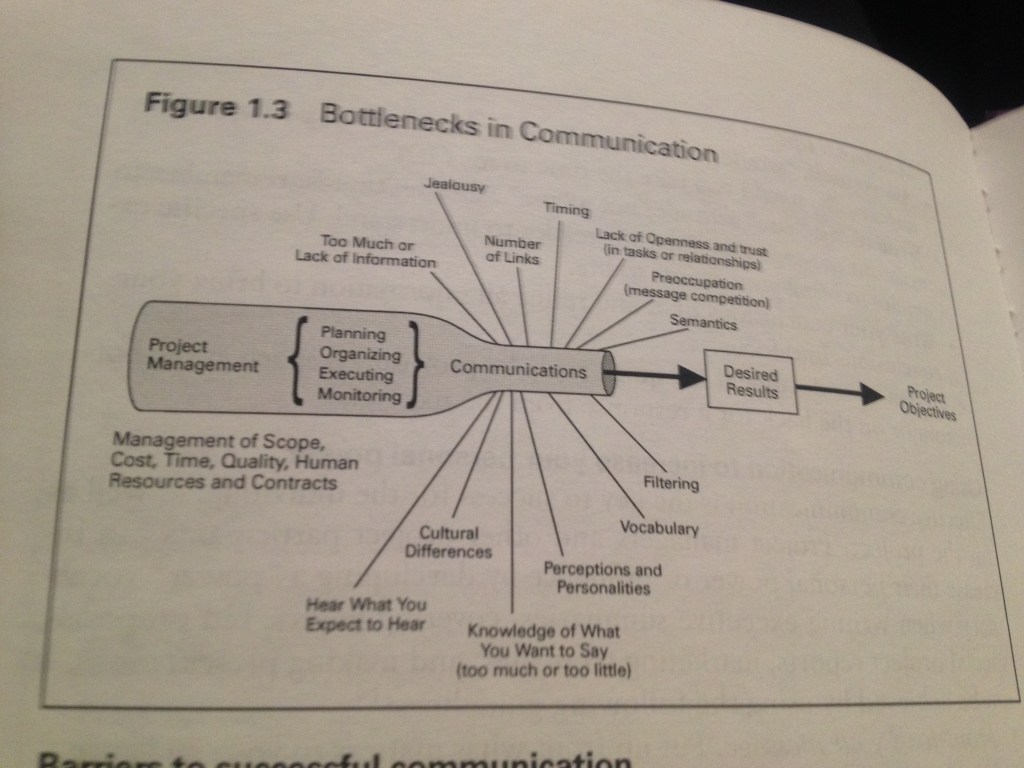
Here is a great illustration of the bottlenecks of communication, the factors that impact the delivery of “effective” communication, and where communication often breaks down:
Furthermore, the majority of effective communication processes involve the typical “feedback/response” model. This involves a sender and receiver. The sender is responsible for encoding the message they want to deliver to ensure the receiver understands and interprets the information accurately. The receiver is then responsible for decoding the message and verifying that it matches the original message. This is often done by repeating the message back to the sender.

According to the Project Management Body of Knowledge (PMBOK) Guide, Sixth Edition, “Communication develops the relationships necessary for successful project outcomes.” Communication extends from sending emails to project progress reports and all facets and formats in between.
Like anything, becoming an effective communicator takes persistence, patience, and practice. I admit that in the earlier days of my career, I wasn’t always a proactive and effective communicator. I would get too wrapped up in the “daily whirlwind”, rushing from meeting to meeting and responding to Slack messages and emails on the fly. As a result, I wouldn’t always communicate clearly, or I would forget to communicate an important update altogether! Approaching my work this way over the long term would have been detrimental to my career. I had to make a change.
Here’s what I’ve learned and what you can do to apply effective communication to your everyday life:
Prevent Conflicts Before They Arise
Although we can’t always prevent conflicts before they arise, we can try. There are several areas—in both the business world and in life—where conflicts can and often arise:
- Decision-making
- Defining roles and responsibilities
- Calling a task “done”
Whether it’s developing a new feature for a digital product or weed-whacking the backyard, different individuals might have different ideas of what their role might be in the task, and what they consider “done” to be.
When developing a new feature, a software engineer builds the front-end user interface (UI) according to an approved design system. “Done” means the feature is 100% built and functional, and all testing has been completed.
Weed-wacking the backyard is a homeowner’s or possibly a tenant’s responsibility. “Done” means that there are no visible weeds or long grass within the confines of the property.
Of course, these are just some examples, but they are often the potential “friction” points and sources of conflict and argument among team members, stakeholders, and even partners and spouses.
Understanding the “friction” points allows you to be proactive in your communication, discussing these items and decisions with teams, stakeholders, or your partner before executing “the work”.
Be Direct Without Being Rude
This is an art form, but it is possible. But, like anything, it requires practice. If you are someone who is often quick to respond, either on the defensive or without thinking, then this will require a great deal of practice, patience, and persistence, not only with others but also with yourself.
Here are some things to try to keep in mind:
- Before responding, listen to the other person, even if they are rude. Take a breath, think, and then respond. You will be the bigger—and better—person because of it.
- Ask clarifying questions, or for evidence or examples to back up their claims, statements, or opinions.
- Focus on the facts and the main issue at hand. Avoid going down rabbit holes or getting into the weeds.
- Use “I” statements. Say “I feel…” rather than “You always”.
Practice Active Listening
- Be compassionate to others’ thoughts, feelings, perspectives, boundaries, and opinions.
- Be open-minded and widen your perspective while listening to others.
- Summarize conversations to ensure effective communication exchange.
- Be present and listen. Rather than thinking about what you will say or how you will respond, focus on the speaker. This is often where information gets overlooked.
- Be aware of cognitive biases. When the speaker makes a statement, don’t simply take it at face value. Rather, ask how he or she arrived at the conclusion as well as his or her reasons for supporting the conclusion. What data or source supports their conclusions or opinions?
- Be aware of cultural and personal differences.
Remember, communication is more about LISTENING than speaking.
Ask Questions
In an ideal world, everything another person said would be crystal clear. However, we live in a world of ambiguity, and we often find ourselves in a position where we must seek to understand another person’s perspective.
Asking questions helps us not only be great listeners but also improve our own communication skills. Asking questions is useful when reacting to what you are hearing or reading. It is also useful when improving our own writing, speaking, and critical thinking skills. In fact, one of the most important questions you can ask is WHY.
When you ask a speaker questions, you proactively act as an active searcher and active thinker. This is an excellent critical thinking and problem-solving strategy that allows you to clarify elements in a speaker’s argument. This process also involves seeking out a speaker’s reasons and conclusions, clarifying any ambiguity, identifying assumptions, and fact-finding.
The knowledge you gain from asking questions not only encourages your own individual thinking and opinions but also provides a foundation for more complicated thinking and better problem-solving in the future.
Clarify for Context
When you listen to someone speak or read a message, email, or article, it is often challenging to interpret it accurately, especially when the speaker or author uses ambiguous language.
Furthermore, language and word choice can differ with geography and culture. Writers and speakers rarely define what they specifically mean by using certain words and phrases. Of course, you could always look up the meaning of a specific word, but there’s no guarantee that the definition provided by the dictionary is the intended definition the speaker or writer gave you. The speaker or writer could have even used the word correctly.
This is why context is so important. And, as the listener, it’s up to you to clarify. You can do this by asking for additional context and examining that context carefully to determine the meaning behind the author’s or speaker’s key terms and phrases.
Practice Conflict Resolution
- Control your emotions during difficult conversations. This is where your conscious battles with the subconscious. Focus on logical thinking rather than reacting with emotional responses. This is where emotional intelligence comes into play.
- Practice active listening. Ask questions to identify the individual or speaker’s core issues, conclusions, and reasons behind them.
- Clarify any ambiguous words or phrases.
- Identify any assumptions and seek out the facts.
- Rather than argue, seek understanding. (If you need to argue, then practice GOOD arguments using effective negotiation tactics.)
- When resolving a conflict, ask yourself what you could have done better.
Practice the Art of Rebuttal
This is a fancy way of “pushing back” while in a discussion, argument, or debate. When participating in and contributing, carefully and actively listen to the speaker and ask yourself the following:
- Are the reasons that support the argument factually true? (Does the speaker provide sufficient evidence and reasons to support their argument? Are they true?)
- Are there reasons important and/or relevant to the argument?
- Are there better alternatives to consider?
Develop Effective Communication Artifacts
- Recall the purpose and goal of the conversation. If it’s helpful, clearly say, “Here’s what I’m hoping we can get out of this…”
- Develop a communications chart or matrix (see example below).
- Use a decision matrix to make better and more informed decisions, resolve conflicts, communicate those decisions, and keep your mental immunity in check.
Manage and Facilitate Meetings
- Use a meeting framework to help you properly prepare for meetings, presentations, and conversations (especially difficult ones). It’s okay to take notes during your conversations, but be sure to communicate why so the listener and other attendees don’t get the wrong idea.
- Take notes or record meetings using an AI note taker. (I use this tool, and it’s awesome.)
- Practice the art of “skilled” interruptions. Facilitating large meetings involving many stakeholders and discussing highly technical or complex topics can be incredibly challenging. It is also easy for these types of meetings to veer off-topic or down rabbit holes. I’ve learned the hard way that interrupting is sometimes necessary in the world of business. This is known as the Point of Information (POI). It’s important to learn to speak up when you notice the first signs of rabbit holes —topics or issues that need further clarification. Not only will this help you boost your confidence, but you will also gain more control of your time and outcomes.
How to Build a Communications Plan
Ensuring effective communication in any area of business is incredibly important. This is especially important if you are in a position where you need to develop and manage cross-functional or departmental communications. The best way to prepare for effective conversations every time is with a communications plan.
What is a Communications Plan?
So what exactly is a communication plan? What does it look like? How do you create one?
By definition, a communication plan defines exactly how specific information should be communicated throughout an organization or project. Not only does the plan outline who should receive information, but it also details how and when they receive it.
Every communications plan looks different for each organization. Ideally, the communications plan should be developed based on the organization’s individual needs. A standard communications plan typically includes the following elements:
- Organizational charts
- Acceptable channels and/or technologies used for communications (i.e., email, chat, meetings, and so on)
- Stakeholders included in specific communications
- Communication frequency (how often a particular communication is disseminated)
- Relationships between stakeholders
- Communications format and artifacts (i.e., meeting frameworks, email templates, memos, status reports, and so on)
- Escalation policies and procedures
- Policies and procedures for handling and communicating sensitive or confidential information
- Communications flowcharts that visually demonstrate the flow and exchange of information
- Legal requirements
There are two parts to effective communication:
- Communications Strategy (The WHAT): Develop a communications strategy that allows you to organize what types of communications are important, and execute communications effectively. (This ensures the right messaging and information reaches the right stakeholders at the right time, and in the right format.)
- Communications Plan and Artifacts (The HOW): How communications will be executed, monitored, and what supporting documentation—or artifacts—will be used in the process.
Involving all stakeholders in the process of defining appropriate communications strategies is important for developing and maintaining stakeholder relationships, and is becoming a standard practice.
As mentioned above, communications planning can be tailored according to the specific project and stakeholder needs. To do this, when developing a communications plan, ask yourself the following:
- Are stakeholders internal or external, or both?
- Where are all stakeholders located? What are their time zones?
- What are stakeholders’ preferred methods of communication?
- What communications technologies are being considered for use? Which are the most appropriate to use?
- How many languages are used?
- Is there a knowledge management system or repository?
Although a relatively simplistic version, here is a copy of the communications plan we share in our new client onboarding packet:

Key Communication Takeaways
In summary, according to Bob Burg in his book The Art of Persuasion, there are three essential elements for every form of verbal and written communication:
- WHAT – Know what you want
- WHO – Know who can give it to you
- HOW – Follow the “3 P’s” and use diplomacy and tact whenever possible
Regardless of our own personal communication strengths, weaknesses, styles, and work habits, we all have the power and resources to improve our communication habits, allowing us the confidence to facilitate effective communication in any setting.
Remember, effective communicators strive for clarity. Be proactive when communicating; it’s up to you to clarify!

 bossladyworld.com
One thought on “23 Ways to Improve Business Communication [UPDATED]”